Awards Eligibility 2024

I have one story that is eligible for awards consideration this year:

Dead reckoning in 6/8 time: A novelette-length story about the ghost of an immigrant mother; her adult daughter who lives uneasily in two worlds; the magic of Son Jarocho music, and the effort of both mother and daughter to out-dance the Devil.

Some background: My mother spent many of her formative years in Boca del Rio, Veracruz. A Mexican citizen for half her life, and a Guatemalan citizen the other half, she knew a thing or two about having feet in two worlds. I remember attending a number of folklórico performances with her in Mexico City (a city she loved in all its many manifestations) and understood that when we hit the Son Jarocho segment, she’d go uncharacteristically quiet, wholly in the grip of memory and its soundtrack.

She was both like and unlike Adriana’s mother in the story. A few weeks after her death, I was in my parents’ house in Pennsylvania, complaining aloud to myself about all the unfinished business she had left for me, when one of her sculptures (she was a professional artist) pretty much leapt off the wall and bonked me on the head. She had had enough of my whining — it was time to get on with the work at hand.

I am not haunted by my mother, as Adriana is, but, as I say in the story, there is a “bone-deep link between mother and daughter that outlasts everything: unsaid words, bad choices, death.” 

If you haven’t read it yet, go give it a read at GigaNotoSaurus — a publisher you definitely want to follow — and if you like it and are nominator for Nebulas, Hugos, or any other such awards, please consider giving it a nod.

By the way, in advance of reading the story (or after reading it), if you don’t know what the Son Jarocho zapateado looks like, here is an example:

@i.travel.mexico

¡El Zapateado Veracruzano es increíble! Música y danza se conjugan en su expresión máxima: el zapateado. El son veracruzano es un género que bailan parejas sueltas y enfrentadas. La danza no es menos compleja y rica que la música y requiere igualmente del virtuosismo. Nos encanta una frase de la bailadora tradicional Rubí Oseguera Rueda: “El zapateado es como el corazón del son, es lo que hace que nos conectemos con la tierra. Los propios músicos te dicen que si no hay nadie bailando y no escuchan el zapateado, algo les falta”. El Zapateado Veracruzano, considerado uno de los más desafiantes, posiblemente tiene sus raíces en la fusión de fandanguillos y sevillanas españolas, influenciadas por elementos de la cultura africana. Arraigado en Veracruz, evolucionó con un toque distintivo y alegre que refleja la vibrante cultura regional. En las tradiciones veracruzanas, la danza y la música, especialmente los sones jarochos, se entrelazan para crear un ritmo intenso, formando una parte integral de su estructura musical. ¡El Zapateado Veracruzano es increíble! 💃❤️ ¡Veracruz es increíble! ¡México es increíble! 🇲🇽❤️ #zapateado #zapateadoveracruzano #jarocho #jarocha #veracruz #mexico #viaje #turismo #travel

♬ sonido original – i.travel.mexico

And if you want to glimpse jaraneros and bailadores in a fandango together, check out this video from a fifth-generation traditional son jarocho bailadora (in Spanish):

https://www.facebook.com/share/v/1AkwPwzthG

New at PRI: What does protest sound like? For this Philadelphia activist, it’s the eight-string jarana.

12814652_10207771787026923_5290174388742298506_n
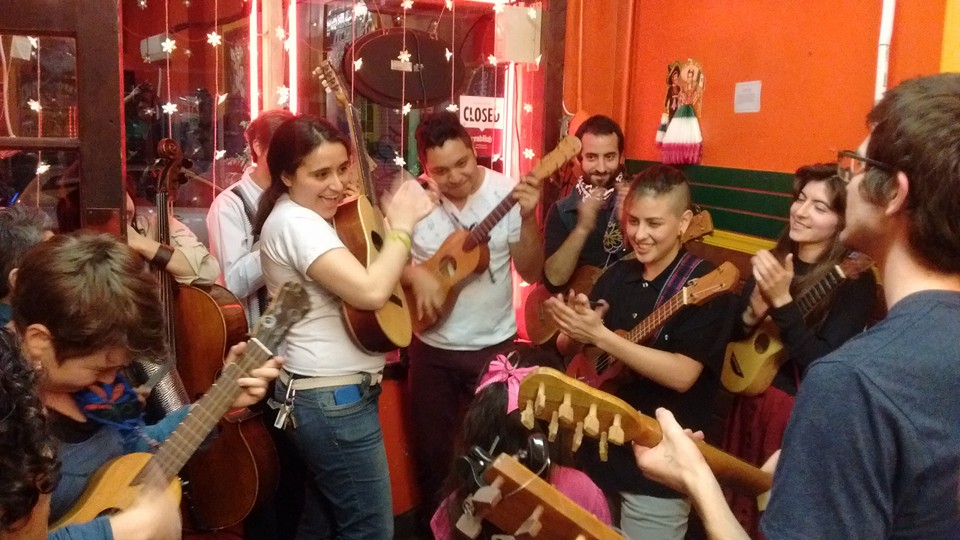
Yared Portillo, center, playing with other members of Son Revoltura at the former Taquitos de Puebla on Calle 9, South Philly’s Mexican immigrant business corridor. Photo: Son Revoltura’s facebook page.

Yared Portillo, a Philadelphia community activist, has four of them: One she built from scratch; two others were secured from renowned artisans; the final one — received broken and in pieces from a friend — she carefully repaired and made whole again.

The repaired instrument isn’t a bad metaphor for the role the jarana has played in the US immigration protest movement for the past two decades. It’s a small, eight-string instrument from Veracruz, Mexico, patterned after a 16th century baroque Spanish guitar that is often confused with a ukulele.

In the hands of Chicanos or recent Mexican immigrants, the jarana — as well as the son jarocho musical form with which it is inextricably associated — energizes rallies and undergirds the chants of those who want to repair not only a broken immigration system, but the increasingly broken relationship between two nations sharing both borders and histories.

Read the rest of the article at PRI’s The World: What does protest sound like?